CJ—Dawn
A Dog's JourneyCJ and Dawn’s relationship begins in the hospice, where CJ recognizes in a frightened teenager a struggle she had endured herself. By speaking openly about her own past and offering practical, continuing support, CJ helps Dawn face her eating disorder without taking ownership of Dawn’s recovery. Their bond lasts beyond that first conversation: Dawn later returns as a young adult, speaks of her plans for medical school, and tells CJ that she saved her life.
Recognition at the Hospice
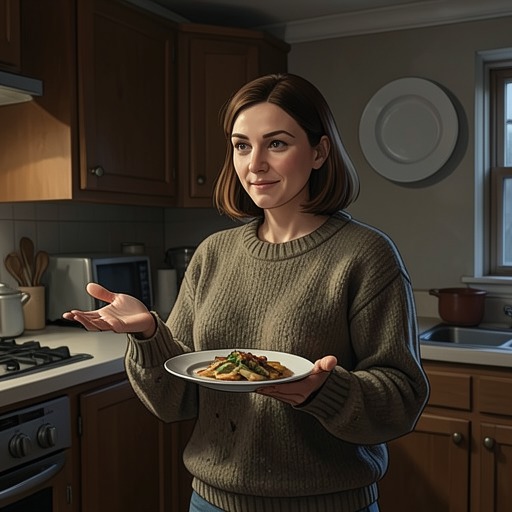
Dawn first appears while her mother is lying in bed, suffering and close to death. Her father and siblings are there, and one of the children places Toby beside their mother. CJ notices Dawn, the oldest child, and invites her to have coffee. Dawn’s alarm at the invitation is perceptible to Toby, who is present as a hospice dog; even before they speak privately, the conversation is framed by a household under strain and a girl wary of what CJ may have noticed.
CJ begins with a seemingly ordinary question about comfort foods. Dawn names peanut butter and heat-and-serve lasagnas, and CJ observes that eating can help with stress. Rather than leave the subject at that general observation, she asks what happens after Dawn has eaten too much. Dawn sits upright and challenges the question. CJ has recognized a pattern that Dawn has not volunteered, and the turn from casual talk to confrontation makes clear that the coffee invitation is not simply a distraction from the family’s crisis.
Disclosure and a Conditional Promise
CJ answers Dawn’s alarm with her own history. In high school, she says, eating made her feel better, but she hated herself for eating and feared becoming fatter; she then got rid of what she had eaten. Her account is specific enough to name both the relief and the self-reproach in the cycle, while making clear that she is not approaching Dawn from a distance. CJ does not describe Dawn as a problem to be corrected; she offers the difficult knowledge of someone who has lived through a related experience.
When Dawn asks how CJ got rid of the food, CJ does not spell out the method. Instead, she makes clear that Dawn already knows what she means. She then asks Dawn to stay a little longer and discloses a physical consequence of her own past: the teeth she has now are not her original ones. She lost them while young because of the acidity, and had implants in college. The detail gives her disclosure a lasting bodily dimension; her experience is not presented as an episode that simply ended when the behavior did.
Dawn’s next concern is whether CJ will tell her father. CJ does not offer an unconditional promise of secrecy. When Dawn asks whether her mother knows, CJ replies by asking her to remain with her, then tells her she is on her side and asks her to call whenever the urge becomes uncontrollable. She will keep Dawn’s confidence only if she is sure Dawn will not hurt herself. That boundary joins trust to responsibility: CJ offers discretion, but not at the cost of Dawn’s safety. Dawn leaves the conversation wanting to return to her mother, and CJ’s offer is for the days and weeks ahead, not a demand for an immediate resolution.
Support That Continues
The later visits show that CJ’s offer became an enduring connection. As CJ grows weaker, many people visit her, including Dawn, now a young adult. Dawn sits beside her and talks for hours. She is thinking about applying to medical school and says she cannot yet know which specialty will appeal to her because she has not even been accepted. CJ answers with confidence that she will be accepted. The exchange reverses their earlier positions without erasing them: CJ had once been the person who recognized Dawn’s distress and offered guidance; now Dawn brings her ambitions and uncertainty to CJ’s bedside, and CJ continues to encourage her.
Dawn says that CJ has always believed in her and that CJ saved her life. CJ refuses the role of sole rescuer, answering that Dawn saved her own life and invoking the principle she has learned in the program: no one else can do it for a person. Her response does not reject Dawn’s gratitude. Instead, it gives Dawn credit for her own effort, treating help as support for another person’s agency rather than a substitute for it. Their conversation ends in an embrace. When Dawn leaves, she wipes away tears, and CJ tells her she can always call.
A Lasting Bond
The relationship’s intimacy is conveyed through repeated acts of attention rather than through a formal account of recovery. CJ first asks about Dawn’s eating, listens as Dawn reacts, shares the consequences of her own experience, and offers a way to reach her when the urge returns. Later, she receives Dawn’s news and affirms her future. These exchanges make the relationship reciprocal: CJ’s history gives Dawn a point of recognition, while Dawn’s visit and affection bring companionship to CJ in her final illness.
Toby’s perspective places their connection among the physical and emotional needs of the hospice. He watches families reach for comfort, stays with patients, and observes that CJ’s pain eases during visits. After Dawn and CJ embrace, he settles beside CJ as she falls asleep. The narrative does not claim that their conversation cures Dawn or removes the grief surrounding her mother’s illness. Instead, it follows a more modest and sustained form of care: CJ makes her own history available, sets a safety-conscious limit, and remains someone Dawn can return to. Dawn’s later words—crediting CJ while also accepting that she saved herself—give that support both its emotional force and its measure.